| |
Unlocking data-driven solutions for cardiovascular care
| |
| |
| |
Welcome to the CVDLINK newsletter! | |
CVDLINK is a collaboration between clinicians, tech developers, research centres, and ethicists. Together, we aim to harness the power of data to create AI tools to aid in the treatment of cardiovascular diseases. Our goals include securely integrating medical, clinical, genetic, and other real-world data sources into a federated and FAIRified dataset; creating AI tools to aid in the treatment, diagnosis, and prevention of cardiovascular diseases; and developing a Platform-as-a-Service for healthcare providers and researchers, validated by studies in five countries. We are sending newsletters roughly every six months until the end of the project - follow us for updates about our research, activities, and other outputs. | |
| |
| |
| |
| |
| |
| |
| |
It’s been a busy stretch for the project since our last newsletter in March 2025. Last June, partners met in San Sebastián for a face-to-face meeting, and the consortium successfully completed their first review with the European Commission in September. Our partners have published articles in a number of journals and presented our work at events, including the IEEE Engineering in Medicine and Biology Conference, among others detailed below. Read on for our highlights from the past few months! | |
| |
| |
| |
Spotlight: Academic publications | |
CVDLINK partners have successfully published a number of scientific articles in recent months, with more on the way soon. Check them out below - and head to the publications page on our website for a full list of scientific publications and other reports. | |
| |
Publication: Privacy-preserving multicenter differential protein abundance analysis with FedProt (Nature Computational Science) | |
| |
CVDLINK partners at the University of Hamburg recently published an article in Nature Computational Science informed in part by their work in the project. The article covers their development of FedProt, a privacy-preserving tool which enables collaborative protein analysis using federated learning. The tool allows researchers to perform large-scale studies across institutions without sharing sensitive patient data - much like the federated data repository currently in development by the CVDLINK team. The results showed the FedProt tool outperformed standard meta-analysis and matched other conventional analyses, paving the way for ethically compliant data sharing in large-scale medical studies. | |
| |
Publication: Predicting long-term risk of sudden cardiac death with automatic computer-interpretations of electrocardiogram (Frontiers in Cardiovascular Medicine) | |
| |
In a publication in Frontiers in Cardiovascular Medicine, CVDLINK partners from Tampere University evaluated whether automatically interpreted electrocardiogram (CIE) data could be used to predict the risk of long-term sudden cardiac death (SCD) in patients with acute coronary syndrome. The findings indicate that while CIE-based models showed only moderate predictive power, they did reliably identify patients at low risk. The study suggests that routinely available CIE data can be used to support future large-scale, cost-effective SCD risk assessment. | |
| |
Publication: Atrial fibrillation and the risk of sudden cardiac death: Incidence, impact, and implications (Heart) | |
| |
Our partners from Tampere University published an article in Heart investigating the link between atrial fibrillation (AF) and sudden cardiac death (SCD) in over 21,000 patients who underwent coronary angiography between 2007 and 2018. The investigation, which was informed in part by research undertaken in the CVDLINK project, found that one-third of SCD cases involved patients with known AF, and one-fifth had AF on their last ECG. These findings highlight the importance of monitoring AF patients for heart failure, in order to better prevent SCD. | |
| |
| |
| |
| |
| |
Abstracts from the International Congress on Electrocardiology 2025 | |
Our partners from Aristotle University of Thessaloniki recently presented three abstracts at the International Congress on Electrocardiology 2025. The abstracts are: - Harnessing Machine Learning for Accurate Ejection Fraction Classification in Echocardiographic Imaging
- The Recognition and Utilisation of ECG Signals from Clinical Reports as PDF Files
- Challenges in AI-based Methods for De-identification and Information Retrieval from Clinical Reports of Heart Failure Patients
For more details, check out the article linked below. | |
| |
Abstract from the 14th Scientific Conference of the Department of Medicine, Aristotle University of Thessaloniki | |
| |
Partners at Aristotle University of Thessaloniki presented an abstract at their Department of Medicine's 14th Scientific Conference. More details about the abstract, titled "Towards identifying lists of consensus variants from polygenic risk scores for cardiovascular diseases using the PGS Catalog," can be found at the link below. | |
| |
| |
| |
CVDLINK's third plenary meeting in San Sebastián, Spain | |
| |
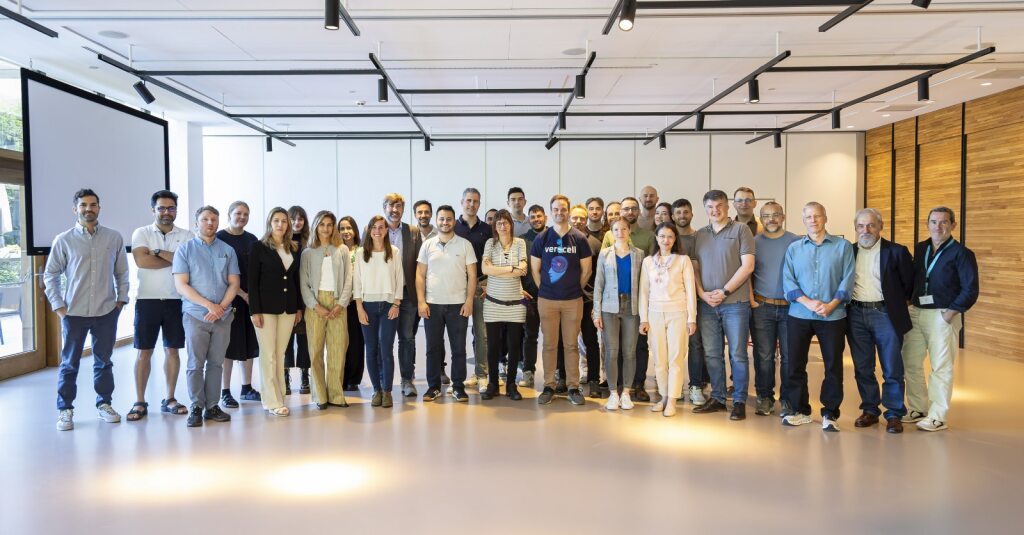
Last May, the CVDLINK consortium met at Vicomtech headquarters in San Sebastián, Spain, for their third in-person plenary meeting. The meeting brought together clinicians, technical experts, researchers, and ethicists to discuss the challenges faced by the project and brainstorm solutions. Read the blog linked below for a summary of key highlights. | |
| |
| |
| |
| |
Our partners from Kaunas University of Technology (KTU) were recently profiled by Lithuanian Radio Television. The article, which discusses KTU's work in CVDLINK, breaks down the project's approach to maximising the impact of real-world data sources, federated learning, and AI training. You can read it here. | |
| |
| |
| |
| |
AI promises to trigger a healthcare revolution. But a major hurdle remains: trust. Without widespread trust in AI, even the most promising AI-powered medical technologies won't be adopted in real-world settings. To counter this, the CVDLINK consortium focuses on developing AI tools according to the principles of responsible, trustworthy AI. You can read about how our partners at Trilateral Research apply one of these approaches, the Privacy Impact Assessment+ methodology, in the blog linked below. | |
| |
| |
| |
| |
| |
The CVDLINK project brings together 19 partners from various backgrounds, including clinicians, AI experts, technology developers, and ethicists. For more information on the project partners, visit our website. | | | |
| |
| |
| |
Forward this newsletter to your network, and they can sign up right here. | |
By signing up for our newsletter, you are giving us consent to process your name and email address. For further information visit the dedicated Privacy Policy on our website. | |
| |
| |
| |
| |
Funded by the European Union. Views and opinions expressed are however those of the author(s) only and do not necessarily reflect those of the European Union or the European Health and Digital Executive Agency. Neither the European Union nor the granting authority can be held responsible for them. | | | |
| |
You are receiving this email because you have expressed interest in the project (informed consent, GDPR Art. 6.1.a) or because you work in a field related to the topics covered by the project (legitimate interest, GDPR Art. 6.1.f.). Want to change how you receive these emails?
You can Unsubscribe or Update your preferences
| |
| |